

Walk into any supply catalog and the list of ostomy accessories goes on for pages. Rings, strips, pastes, powders, belts, covers, wraps, guards, sprays. If you're new to this, it's hard to tell which of these you need and which are just nice to have.
So here's my short list. I've lived with an ostomy since 2008 and have been designing and wearing ostomy belts every day since 2009. This is what I'd tell a friend who just got home from the hospital.
Contents
- What Counts as an Ostomy Accessory?
- The Ostomy Accessories I'd Put on Every List
- Accessories That Help in Specific Situations
- Ostomy Accessories in the First Few Months
- How to Decide Which Ostomy Accessories You Need
- A Simple Everyday Ostomy Kit
- A Word for Ostomy Nurses
- Frequently Asked Questions
- A Note From Richard
What Counts as an Ostomy Accessory?
Your pouching system is the pouch and the skin barrier (often called the wafer) that sticks around your stoma. An accessory is anything you add on top of that to make it work better, last longer or feel better.
The Ostomy Canada Society groups accessories into a few families: belts that hook onto your pouch or flange, moldable rings, flange extenders that help stop edges lifting, and products for cleaning adhesive off your skin. That's a good way to think about it. Each accessory solves one problem.
That last part matters. You don't need all of them. You need the ones that fix something in your day.
The Ostomy Accessories I'd Put on Every List
These are the ones I use or recommend most often. Your list may look different, and that's fine.
A Supportive Ostomy Belt
This is the one I'd never go without. A belt holds the pouch close to your body and carries some of its weight, so the wafer isn't the only thing holding everything up. As the pouch fills, that weight pulls on the seal. A belt takes some of that pull away.
For me, it's about being able to move without thinking about my pouch. I teach martial arts. I surf. I chase my kids around. I wear a belt for all of it, and I sleep in it too.
I designed the HIRO Performance Vertical belt and its horizontal version around what I needed as someone who wears a belt every day: real adjustability, breathable fabric and stitching that holds up. If you're shopping for one, measure your waist just above and below your stoma and average the two numbers. The sizing guide on our site walks you through it.
Barrier Rings or Strips
A moldable barrier ring sits under your wafer and fills small gaps and creases around the stoma. Barrier strips go around the outer edge of the wafer to help hold it flat.
I use both. With rings under the flange and strips around the edge, my appliance usually lasts about five days to a week.
If you're getting leaks or sore skin, ask your nurse whether a ring could help. Getting the seal right matters more than any other accessory.
Adhesive Remover
Pulling a wafer off dry can be rough on your skin, especially if you change often. Ostomy Canada notes that mild soap and water is the ideal way to clean off adhesive residue. Some people add a medical adhesive remover spray or wipe to make removal gentler. Check with your nurse about which suits your skin.
A Stoma Guard for Bumps and Pressure
A seatbelt across your stoma. A toddler climbing onto your lap. A dog who jumps up to say hello. If any of that makes you flinch, a stoma guard is worth a look.
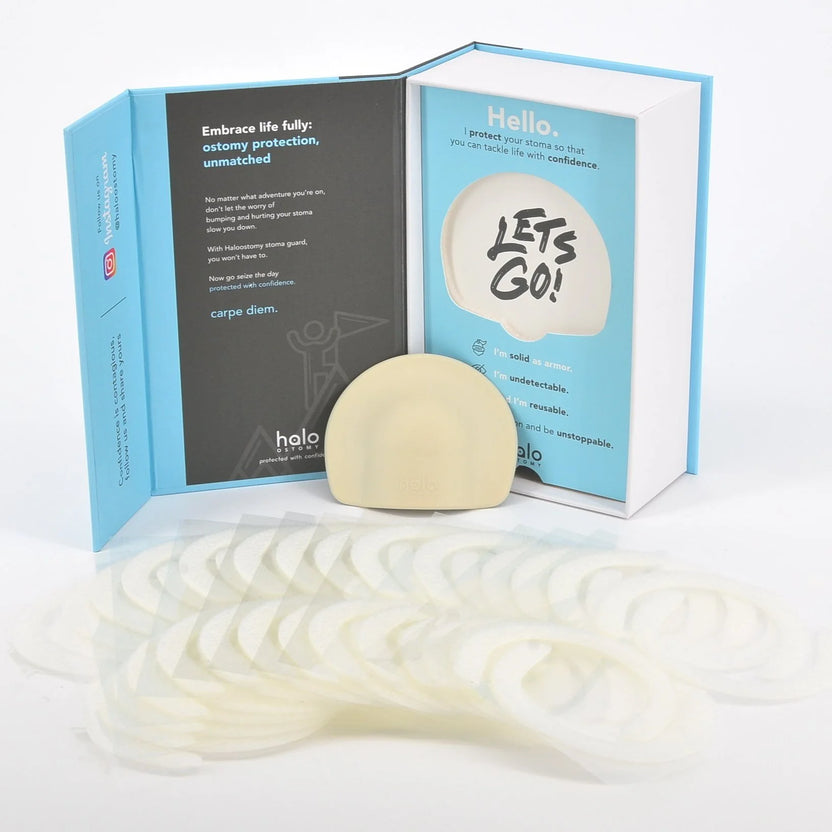
I wear a Halo Stoma Guard Kit for seatbelts, martial arts and anytime I'm wearing a tool belt. It's a hard, low-profile shield made by Halo Ostomy, and it sits over the stoma inside the belt. The belt handles support. The guard handles impact. I wrote more about how a guard protects your stoma on busy days.
A Pouch Cover or Wrap, If It Suits You
Some people love a fabric pouch cover. It keeps plastic off your skin, can soak up a bit of sweat and changes how the pouch looks. Others prefer a wrap, a wide band that goes around your middle and covers the pouch.
Neither is a must. A belt that keeps the pouch flat under your clothes can mean you rarely need one. But if you're dealing with sweaty skin, want a different look for intimacy or just feel better with the pouch covered, they're an easy, low-cost thing to try.
Accessories That Help in Specific Situations
Some ostomy accessories aren't everyday items. They're tools you reach for when a certain problem shows up.
- Flange extenders: Curved adhesive strips that go around the edge of the wafer. Ostomy Canada describes them as adding security and helping stop edges from lifting.
- Odor eliminators: Drops or sprays that go inside the pouch. The Crohn's & Colitis Foundation's ostomy tips and tricks mention these as an option for odor control.
- Pastes and powders: Paste can fill uneven skin. Powder is used on irritated, weepy skin. Both are best used the way your nurse shows you, because using too much can cause more problems than it solves.
- Travel extras: A spare kit in your carry-on, pre-cut wafers and something that explains your ostomy at security. We made a free TSA travel card you can print from the free printables page on our site.
Ostomy Accessories in the First Few Months
The early weeks after surgery are a little different. Your body is healing, and your needs change fast.
- Your stoma may change size: Swelling goes down over the first weeks. Ask your nurse to re-measure before you stock up on pre-cut wafers or rings.
- Support is often recommended early: You don't have to wear a belt, but many nurses suggest some support in the first weeks and months while your abdominal wall heals. Check with your surgeon before you start, since timing depends on your surgery and recovery.
- Food affects output: What you eat changes how fast your pouch fills, which changes how much support you'll want. I shared some recovery diet tips from my own experience.
- Hold off on bulk buying: Wait until your routine settles before ordering large boxes of anything.
How to Decide Which Ostomy Accessories You Need
This is where most people go wrong first. It's easy to buy a bag full of products in the first month, try three at once and not be able to tell what helped.
Here's a simpler way.
- Start with the problem. Are you leaking? Is your skin sore? Do you worry about the pouch pulling when you move? Name the one thing that bothers you most.
- Match one accessory to it. Leaks and sore skin point toward the seal: rings, strips or a better-fitting wafer. Pulling and shifting point toward support: a belt.
- Change one thing at a time. Give it a week or two. Then you'll know if it worked.
- Bring your nurse in. Your ostomy nurse can look at your stoma and skin in a way no article can. Memorial Sloan Kettering's guide to caring for your ileostomy or colostomy is a good primer before that visit.
- Check coverage. Some accessories may be covered. In the US, ostomy belts are billed under HCPCS code A4367, so insurance or FSA/HSA funds may reimburse you with an itemized receipt. Plans vary, so ask yours first.
A Simple Everyday Ostomy Kit
If you want a starting point, here's a simple setup to build from. Adjust it with your nurse.
- On your body: Wafer and pouch, a barrier ring if you need one, strips around the edge if your wafer lifts, a support belt, and a stoma guard for driving or contact activities.
- In your bag: A spare pouch and wafer (pre-cut if you can), a spare ring, a few wipes, a small disposal bag and a change of underwear.
- At home: Adhesive remover, scissors for cutting wafers, a mirror for checking the fit and a stock list so you reorder before you run low.
That covers most days. You don't need a drawer full of products you never touch.
A Word for Ostomy Nurses
If you're a WOC or ostomy nurse, you're often the person helping patients sort through all of this. We've put together ostomy belt resources for WOC nurses, including a fitting and order guide and printable patient materials.
And if a nurse made a difference for you, we'd love for you to tell us about them. Through November 30, 2026, sharing a nurse on our Nurse Appreciation Month page gets you $30 off a HIRO belt and enters you in our prize drawing.
Frequently Asked Questions
1. What Supplies Do You Need for an Ostomy?
The basics are a pouch and a skin barrier (wafer) that fits your stoma, plus whatever you use to clean and dry the skin around it. Everything else is an accessory you add when a problem calls for it.
2. Can You Buy Ostomy Accessories Without a Prescription?
Many accessories, including belts, covers and wraps, can be bought directly online. If you want insurance to pay, some plans ask for a prescription or a letter of medical necessity, so check with your plan before you order.
3. What Are the Best Ostomy Accessories?
There's no single best set. The best ones are the ones that fix a problem you actually have. For me, that's a support belt, barrier rings and strips, and a stoma guard for driving and training. Someone with sensitive skin might put an adhesive remover or a pouch cover at the top of their list instead.
4. Do I Need an Ostomy Belt?
No, a belt isn't required. Many nurses suggest some support in the first weeks and months after surgery, and after that it's a personal choice. I wear mine all day, every day, because it lets me move without thinking about my pouch.
A Note From Richard
I've been where you are, staring at a catalog and wondering what any of it is for. The good news is that you don't need much. You need a seal you trust, support that lets you move, and maybe one or two extras for the parts of your life that need them.
Please treat this as one ostomate's experience, not medical advice. Your stoma, skin and routine are your own, so check with your surgeon or ostomy nurse before you change anything.
Start small. Fix one problem at a time. The right ostomy accessories should make your day simpler, not add to the list of things you worry about.
— Richard