

A stoma belt has one job: keep your pouch steady and close to your body. If it rides up when you sit, rolls when you bend or slides around under your shirt, it isn't doing that job. You end up adjusting it all day, which is the opposite of why you bought it.
I've had an ostomy since 2008, and I've been designing and wearing belts every day since 2009, through martial arts, surfing and family life. The difference between a belt that stays put and one that doesn't usually comes down to a handful of things you can check before you buy.
Contents
- What a Stoma Belt Does (and Why Staying Put Matters)
- Why a Stoma Belt Slips in the First Place
- What to Look For in a Stoma Belt That Stays in Place
- How to Test Your Stoma Belt Fit at Home
- Keeping Your Stoma Belt in Place While You Sleep
- Why Some People Keep Two Belts
- Quick Fixes When Your Belt Won't Stay Put
- When to Talk to Your Nurse or Surgeon
- Frequently Asked Questions
- A Note From Richard
What a Stoma Belt Does (and Why Staying Put Matters)
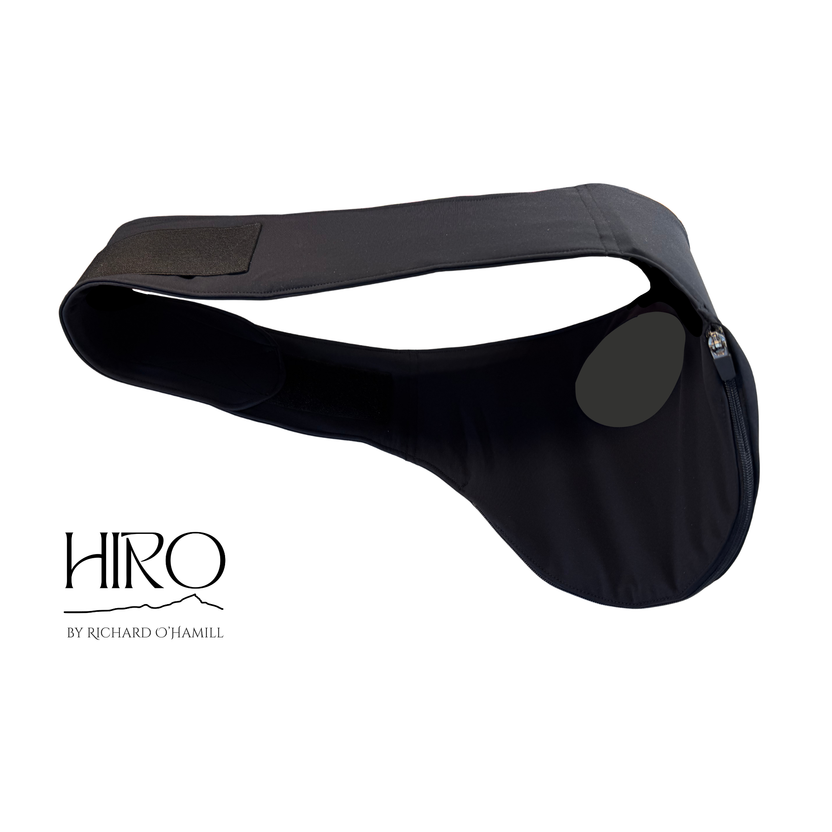
A stoma belt, also called an ostomy belt or ostomy support belt, is an adjustable band that goes around your waist. It has an opening that fits over your pouching system, so the belt holds the pouch flat against your body and carries some of its weight.
That weight relief is the point. As your pouch fills, it pulls on the wafer. A belt spreads that pull across your waist instead.
A 2017 international consensus paper in the Journal of Wound, Ostomy and Continence Nursing on the use of convexity in ostomy care describes belts as a way to support the pouching system, either by stabilizing it or by adding pressure to help the seal. A belt can only do that if it stays where it's supposed to be. Once it moves, the support moves with it.
For a closer look at how a belt fits into a normal day, read why a stoma support belt makes daily life easier.
Why a Stoma Belt Slips in the First Place
Before you look at features, it helps to know what makes a belt move. In my experience, it's usually one of these:
- Wrong size: Too loose and it slides. Too tight and it rides up to find a narrower spot on your waist.
- Measured in the wrong place: Many people go by pants size. Your waist at stoma level is often different.
- Tired elastic: Cheap elastic loses its stretch. Once it does, no amount of tightening fixes it.
- Body changes: Swelling after surgery, weight changes and even a big meal change your waist measurement.
- The wrong opening size: If the opening doesn't match your flange, the belt can't sit flat around the pouch.
- Pouch position that fights your movement: A pouch hanging straight down can get pushed around when you bend, depending on how you move.
What to Look For in a Stoma Belt That Stays in Place
Sizing Based on Your Stoma Line, Not Your Pants
This is where most people go wrong first. Measure your waist just above and just below your stoma, then average the two numbers. Use a soft tape over bare skin or a thin T-shirt.
If you fall between sizes, or you've recently had surgery or changed weight, measure again before ordering. Our size chart shows the waist range for each HIRO size, from XXS (20 to 25 inches) up to XXXL (48 to 53 inches).
Real Adjustability
Your waist isn't the same at 7 a.m. as it is after dinner. A belt that only fits one version of you will slip at some point in the day.
Look for a belt with a decent adjustment range. Each HIRO belt adjusts about six inches within its size. That covers meals, swelling and normal day-to-day changes without needing to buy a new belt.
An Opening That Matches Your Flange
The opening should fit around your pouching system without pressing on your stoma. If it's too small, it can push on the wafer or stoma. If it's too big, the belt has nothing to hold on to and slides.
HIRO belts come with a 2 1/4-inch or 3 1/4-inch flange opening, and in left or right versions for whichever side your stoma is on. If you're unsure which flange size you use, check your supply box or ask your nurse.
Fabric and Stitching That Hold Their Shape
A belt that stays put on day one but stretches out by month three isn't much help. Look for:
- Breathable, quick-dry fabric: Sweat builds up under a belt during a long day. Fabric that breathes and dries fast is easier on your skin.
- Reinforced stitching at stress points: The places where the belt bends and closes take the most strain.
- Construction meant for daily wear: Some belts are built for occasional use. If you'll wear yours every day, it needs to be built for that.
A Closure That Holds When You Move
Plenty of belts feel secure when you're standing still in front of a mirror. The real test is sitting, bending, twisting and lifting. A good closure stays fastened through all of that without you needing to check it.
A Pouch Position That Suits Your Day
Belts usually hold the pouch either vertically (pointing down) or horizontally (to the side). Neither is medically required.
Vertical is the usual setup after surgery. It drains easily and works well for office days and recovery. Horizontal moves the pouch toward your hip, out of the way when you bend, and it's easier for side and stomach sleepers. I wear horizontal because of how active I am.
If you lean toward the side position, the HIRO Performance Horizontal is the style I wear. A vertical version is available too.
How to Test Your Stoma Belt Fit at Home
Once you have a belt on, give it a quick check before you trust it for a full day.
- The two-finger check: You should be able to slide two fingers under the band. Snug, not tight.
- Sit down: Does the belt ride up or bunch? Does the pouch fold?
- Bend and squat: Pick something up off the floor. The belt should stay level.
- Walk some stairs: Any rubbing or shifting will show up fast.
- Lie down on your side: If you sleep in your belt, loosen it a notch at night.
- Check your skin afterward: Deep red lines or grooves mean it's too tight or the wrong size.
If you're active at work, the UOAA's guide to going back to work after ostomy surgery suggests a stoma belt for jobs with a lot of bending. That's a good reason to test the bend and squat moves properly.
Keeping Your Stoma Belt in Place While You Sleep
Night can be tricky. You roll over, the pouch flips or folds, and you wake up checking it.
A belt that fits well helps keep the pouch from pulling or flipping when you turn. I wear mine 24/7 and loosen it a notch at night. If you sleep on your side or stomach, a horizontal belt usually feels better, because the pouch sits toward your hip instead of underneath you.
Why Some People Keep Two Belts
One belt can't be in the wash and on your body at the same time. Having two lets you rotate, so you always have a clean one ready.
Some people go a step further and keep two sizes: a snugger one for sport or busy days and a slightly looser one for relaxing at home. If your weight moves around, that can help too.
Quick Fixes When Your Belt Won't Stay Put
- It rides up when you sit: Recheck your measurement at stoma level. If the belt feels tight, loosen it or size up. If it feels loose, tighten it a little.
- It rolls at the edges: The elastic may be worn, or the belt may be too narrow for your shape. A new belt is often the fix.
- It slides side to side: Check that the opening matches your flange size.
- It digs in or leaves marks: Loosen it or size up. A belt shouldn't hurt.
- It shifts during sport: Consider a horizontal belt, which keeps the pouch toward your hip.
If your output is liquid and your pouch fills quickly, check the fit more often through the day. A heavier pouch puts more strain on the belt.
When to Talk to Your Nurse or Surgeon
A belt isn't a treatment for any condition, and it isn't a substitute for a good seal. Stop and get advice if:
- Your skin is sore, broken or discolored where the belt sits.
- Your stoma changes color or size.
- You notice a bulge around your stoma.
That last one could be a parastomal hernia. A general stoma belt isn't a hernia treatment, and the UOAA's advice on how to deal with peristomal hernias is to get properly fitted, because every body and stoma is different. I've covered this in more detail in my post on parastomal hernia care.
If you're an ostomy or WOC nurse helping patients with belt fit, our fitting and order guide for nurses includes a sizing chart and fit checks you can print.
Frequently Asked Questions
1. Do I Need a Stoma Belt After Surgery?
It isn't required. Many nurses suggest some support in the first weeks and months, when your abdominal wall is still healing. Check with your surgeon before you start wearing one, since the right timing depends on your surgery and recovery.
2. Does a Stoma Belt Work for a Colostomy, Ileostomy or Urostomy?
Yes. A belt is built around the pouch, not the type of surgery. If you have a urostomy pouch with a spout, a vertical belt is usually the better fit, because the spout stays at the bottom.
3. Can I Swim in a Stoma Belt?
Yes, if the fabric is made for it. Look for a belt with breathable, quick-dry fabric. I surf in mine.
4. Will Insurance Cover a Stoma Belt?
Often, yes. In the US, ostomy belts are billed under HCPCS code A4367, so insurance or FSA/HSA funds may reimburse you with an itemized receipt. Coverage varies, and some plans need a prescription, so check with your plan first.
A Note From Richard
I've been where you are, wondering if a belt is worth wearing at all. For me, it is, once you find one that fits.
This is my experience, not medical advice. Your surgeon or ostomy nurse knows your body, so check with them before you change your routine.
Measure carefully, check the opening size and test the fit while you move. A stoma belt that actually stays put lets you stop thinking about your pouch and get on with your day.
— Richard